Fish index, rarity and world records
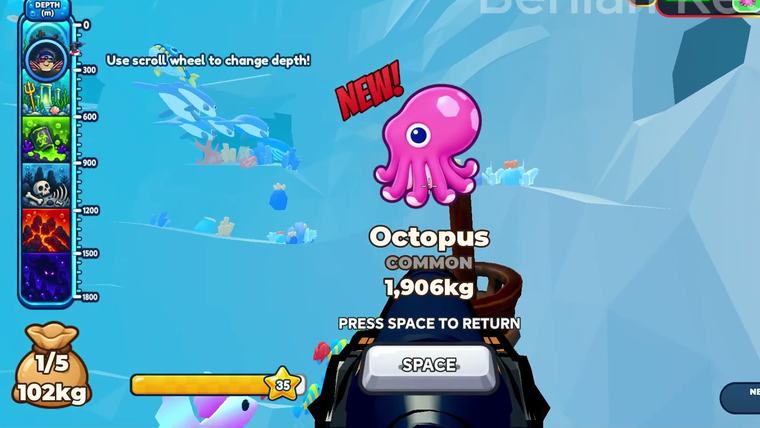
The index fills as you catch, one entry per species, and each catch card shows the species, its rarity tag and its weight. WORLD RECORD is awarded per species, so a record is always relative to the heaviest catch of that one fish.
Harpoon a Fish advertises more than 1,800 unique fish, and the index board on the island is how the game proves it. This page explains what the index actually tracks and how to read a catch card at a glance.

What one index entry costs you
Every species you harpoon adds an entry. There is no purchase, no reroll and no unlock currency - the index advances exactly as fast as your dives do. Practically, that means:
- Index progress is a depth progress report. The shallow band's fish are cheap to fill and finish quickly; the count you are chasing lives in the deep bands, which are weight-gated.
- The index is not a checklist you can shortcut with money. Game passes speed up income and luck, not species discovery.
- You can see what is missing from the island board, which is the fastest way to notice that a recipe or a quest is pointing at a fish you have never caught.
Reading a catch card
The moment you land something, the game shows you a catch card. Three fields on it matter more than the rest:
| Field | What it tells you | Why it matters |
|---|---|---|
| Species name | Which index entry this fills | Duplicates still pay, but they do not advance the index |
| Rarity tag | The tier of the catch, shown with tags such as COMMON | Higher tiers are worth more cash and more index prestige |
| Weight | The catch's size in the units the game displays | Weight is what the record badge compares |
A tag like COMMON on a card is not an insult - the shallow bands are almost entirely common fish, and a full shallow index is a real milestone. It is also a useful filter: a rare tag on a small fish is still worth a bag slot, while a common tag on a big one is usually just cash.
The WORLD RECORD badge, and why it is rare
The game's badge list includes WORLD RECORD - catch the biggest fish of all time, per species. Two things about that sentence are worth reading twice.
- It is per species. A record is always relative to the heaviest catch of that one fish, so a small species can be recordable with a catch that would be unremarkable elsewhere.
- It is scarce. Fewer than 1,500 players have earned it, against hundreds of thousands who own the tutorial badge. Recorders are people who fish the same species at depth, repeatedly, and care about size rather than payout.
If you want the badge, pick one deep-band species, learn where it spawns, and farm it with bait that targets it - that is the entire method.
Rarity, mutations and luck
Rarity is rolled when you land a catch, and the game's own pass description gives away how one part of it works: 2x Luck doubles the chance of triggering a mutation when you harpoon a fish. That confirms mutations exist and that they are a roll on the catch, not a separate item you buy. If you are chasing rare entries rather than cash, luck is the stat that helps.
Building the index without burning your bag
The index and the bag counter pull in opposite directions: bag space rewards value, the index rewards variety.
- Run a variety dive at the top of a new band. Catch everything once, bank the entries.
- Run a value dive after that. Same band, bait that targets the high-value species, ignore the rest.
- Never fill your last two slots with duplicates when a new species is still in the water.
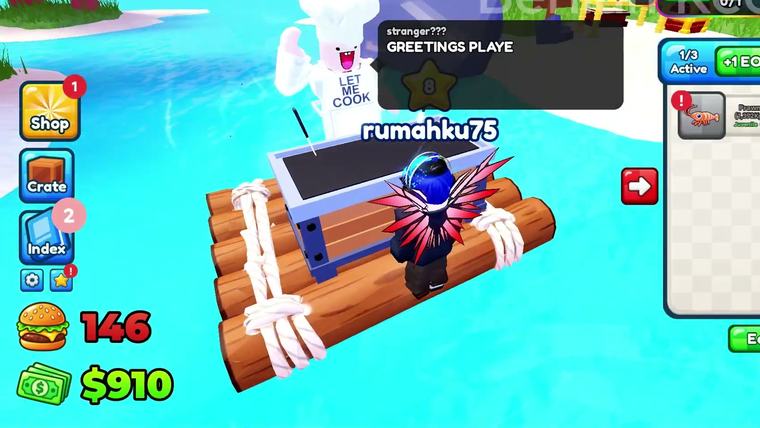
Used that way, one session can both advance the index and pay for your next Mukbang table upgrade - which is exactly the loop the next two pages describe.